


Sections on this Page
- What Is a Protected Trait?
- The 23 Protected Traits in Washington, DC
- Outreach and Training
- Additional Questions, Comments, and Customer Conduct
What Is a Protected Trait?
A protected trait is a characteristic or attribute of a person that is legally safeguarded from discrimination or unfair treatment. In Washington, DC, the DC Office of Human Rights (OHR) enforces the DC Human Rights Act (DCHRA), which makes discrimination illegal based on 23 protected traits for people that live, visit, or work in DC. The DCHRA prohibits discrimination in four areas of enforcement:
-
Educational Institutions,
-
Employment,
-
Housing, and
-
Public accommodation and Government Services
What are the 23 Protected Traits Under the DC Human Rights Act (Updated July 1, 2026)
Below list and defines each protected trait in alphabetic order. Additionally, discrimination protections may not apply to all four areas for each trait, and the applicable enforcment areas have been specified.
You can also download flyers with this information in English and available languages below:
The 23 Protected Traits Definitions and Areas of Enforcement (Updated July 13, 2026)
-
Age:
-
Definition: 18 years of age or older
-
Areas of Enforcement: educational institutions, employment, housing, and public accommodation and government services
-
-
Color:
-
Definition: skin pigmentation, including variations in skin pigmentation
-
Areas of Enforcement: educational institutions, employment, housing, and public accommodation and government services
-
-
Credit Information:
-
Definition: any information about a person’s creditworthiness, credit score, or credit history
-
Area of Enforcement: employment
-
-
Disability:
-
Definition: physical or mental condition that substantially limits major life activities; having a record of such a condition; or being regarded as having such a condition
-
Areas of Enforcement: educational institutions, employment, housing, and public accommodation and government services
-
-
Family Responsibilities:
-
Definition: supporting or contributing to the support of a dependent, such as a child, parent, or grandparent
-
Areas of Enforcement: educational institutions, employment, housing, and public accommodation and government services
-
-
Familial Status:
-
Definition: one or more individuals under 18 years of age living with a parent or other person with legal custody, and includes pregnant persons or those securing custody
-
Areas of Enforcement: educational institutions, housing, and public accommodation and government services
-
-
Gender Identity & Expression:
-
Definition: a gender-related identity, appearance, expression, or behavior of an individual, regardless of the individual’s assigned sex at birth
-
Areas of Enforcement: educational institutions, employment, housing, and public accommodation and government services
-
-
Genetic Information:
-
Definition: information obtained from genetic testing of an individual or their family members indicating increased risk of a disease, disorder, or condition
-
Areas of Enforcement: employment, and public accommodation and government services
-
-
Homeless Status:
-
Definition: an individual or family who lacks or will imminently lose a fixed, regular, or adequate nighttime residence
-
Areas of Enforcement: educational institutions, employment, housing, and public accommodation and government services
-
-
Marital Status:
-
Definition: married, in a domestic partnership, single, divorced, separated or widowed
-
Areas of Enforcement: educational institutions, employment, housing, and public accommodation and government services
-
-
Matriculation:
-
Definition: enrollment in a college, university, or vocational, professional, or adult educational program.
-
Areas of Enforcement: employment, housing, and public accommodation and government services
-
-
National Origin:
-
Definition: the country or nation where a person or their ancestors are from.
-
Areas of Enforcement: educational institutions, employment, housing, and public accommodation and government services
-
-
Personal Appearance:
-
Definition: outward appearance including body characteristics or condition, dress, grooming, facial hair, or hairstyle.
-
Areas of Enforcement: educational institutions, employment, housing, and public accommodation and government services
-
-
Place of Residence or Business:
-
Definition: the geographical location of home or work.
-
Areas of Enforcement: housing, and public accommodation and government services
-
-
Political Affiliation:
-
Definition: belonging to or endorsing a political party.
-
Areas of Enforcement: educational institutions, employment, housing, and public accommodation and government services
-
-
Race:
-
Definition: not defined in the DCHRA. Generally, refers to characteristics associated with a race.
-
Areas of Enforcement: educational institutions, employment, housing, and public accommodation and government services
-
-
Religion:
-
Definition: a personal set or institutionalized system of attitudes, beliefs, and practices relating to a supernatural force or being, or its equivalent in secular faiths, including the presence or absence of commitment or devotion to any faith.
-
Areas of Enforcement: educational institutions, employment, housing, and public accommodation and government services
-
-
Sealed Eviction Record:
-
Definition: eviction records sealed by DC Superior Court.
-
Area of Enforcement: housing
-
-
Sex:
-
Definition: a person’s biological sex and associated characteristics or conditions.
-
Areas of Enforcement: educational institutions, employment, housing, and public accommodation and government services
-
-
Sexual Orientation:
-
Definition: a person’s romantic or sexual attraction to another person.
-
Areas of Enforcement: educational institutions, employment, housing, and public accommodation and government services
-
-
Source of Income:
-
Definition: the origin of a person’s finances, including government payments such as vouchers, subsidies, emergency assistance payments, social security, unemployment, and disability benefits.
-
Areas of Enforcement: educational institutions, housing, and public accommodation and government services
-
-
Status as a Victim or Family Member of a Victim of Domestic Violence, a Sexual Offense, or Stalking (DVSOS):
-
Definition: victim or family member of a victim of domestic violence, sexual offense, or stalking.
-
Area of Enforcement: employment
-
-
Status as a Victim of an Intrafamily Offense:
-
Definition: an individual, their family, or a household member who is a victim of domestic violence, sexual assault, stalking, and/or cruelty to the victim’s animal.
-
Area of Enforcement: housing
-
Outreach and Training
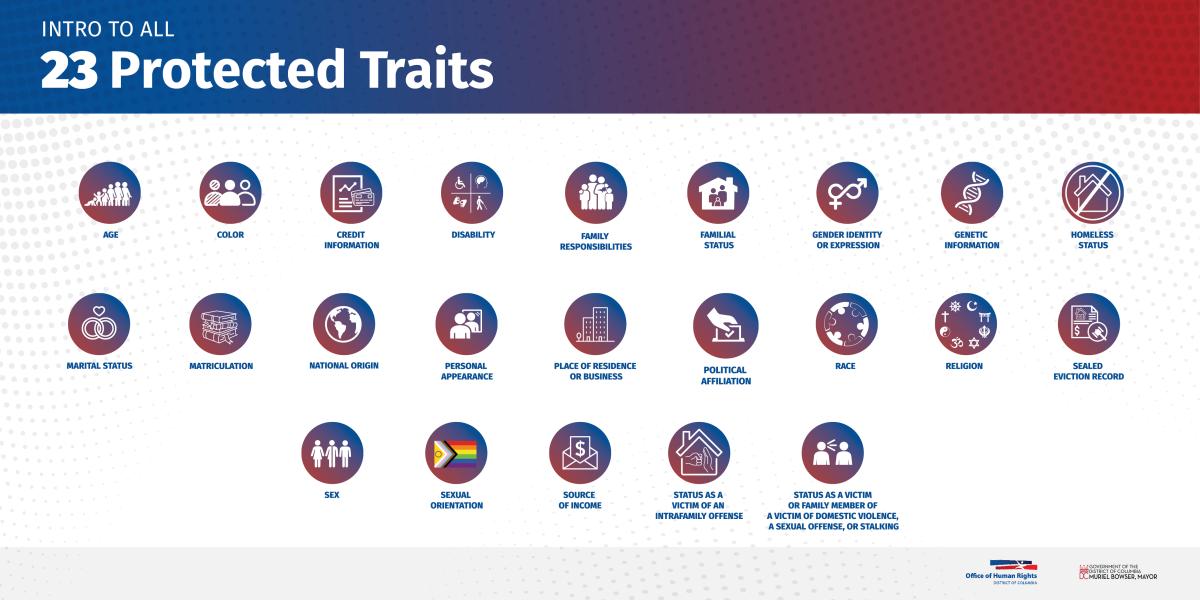
OHR's Communication and Community Engagement (CCE) team offers a 90-minute ‘Know Your Rights’ training session that deep dives into understanding the 23 protected traits by enforcement area. If you are interested in requesting or attending, please sign up for our newsletter or contact [email protected]
Additional Questions, Comments, and Customer Conduct
-
E-mail: [email protected]
- In-Person: 441 4th Street NW, Suite 570N, Washington, DC 20001
- Phone: (202) 727-4559
When you call or visit us and require language assistance, our staff will connect you with a live interpreter to ensure we can assist you effectively.
Please note that while OHR is available to answer questions to the best of our ability, any information provided should not be considered legal advice.
OHR is committed to providing a safe, respectful, and productive environment for all. Harassing, threatening, or abusive behavior interferes with our ability to serve the public and will not be tolerated. You can learn more by reading OHR’s Customer Conduct Policy.
This webpage was last updated on September 3, 2026.